Political - View Point https://1stattorneys.ng/articles Tue, 28 Apr 2026 17:52:50 +0000 en-US hourly 1 https://wordpress.org/?v=6.9.4 https://1stattorneys.ng/articles/wp-content/uploads/2026/05/cropped-1a-32x32.jpg Political - View Point https://1stattorneys.ng/articles 32 32 The Illusion of Democracy https://1stattorneys.ng/articles/2026/04/28/the-illusion-of-democracy/ Tue, 28 Apr 2026 17:52:50 +0000 https://1stattorneys.com/articles/?p=990832

The Illusion of Democracy: A Holistic Examination of What Democracy Promises, Why It Fails to Deliver, and Whether Any System Can Do Better

Introduction: The Great Political Mirage

Democracy in its contemporary form often functions as a ritualized performance, masking the reality of rule by unelected economic elites and unaccountable state apparatuses.

The word “democracy” carries immense moral weight, evoking images of citizens freely choosing their leaders and a system where every voice matters. Since the fall of the Berlin Wall, it has been presented as the only legitimate form of government, the “end of history”. Across the globe, nations proudly maintain the formal architecture of representative government, yet beneath this surface, the substance of democratic governance, accountability, popular sovereignty, and genuine political equality, is often hollowed out while the forms remain intact.

This is the illusion of democracy: a system that looks and sounds democratic yet systematically denies citizens meaningful control over the decisions that shape their lives. Democracy in its contemporary form has become a ritualized performance, a carefully maintained facade that masks the reality of rule by unelected economic elites, entrenched political dynasties, and unaccountable state apparatuses. This condition is global, manifesting as a “third wave of autocratization” characterized by gradual setbacks under a legal façade. Understanding this phenomenon requires deconstructing what democracy is supposed to be and why it fails to manifest in practice.

What Democracy Is Supposed to Be: The Theoretical Ideal

Before we can understand why democracy is illusory, we must state clearly what it promises. At its most basic, democracy means rule by the people (dēmos and kratos). Political theory identifies four core pillars that any genuine democracy must satisfy:

  1. Popular Sovereignty: Ultimate political authority resides in the citizenry. Leaders hold power only if delegated by the people, and policy must broadly reflect the popular will.
  2. Political Equality: Every citizen’s voice carries equal weight. Factors like wealth, birth, or religion cannot confer extra influence.
  3. Meaningful Participation: Citizens must participate continuously in deliberation and accountability, requiring access to accurate information and a free press.
  4. Accountability and the Rule of Law: Leaders are not above the law and can be punished for corruption or abuse of power. The legal system must apply equally to all.

Modern democracy operates as representative democracy, a compromise where citizens elect officials to govern on their behalf. The illusion of democracy begins exactly at the gap between the representative and the represented; when this gap becomes a chasm, democracy becomes a ceremonial mask over oligarchy.

Structural Engines of Illusion: Economic and Elite Capture

⚠
Economic inequality is a primary driver of the democratic illusion, translating concentrated wealth into concentrated political power and violating political equality.

The most powerful engine of the democratic illusion is economic inequality. In every examined case, concentrated wealth translates into concentrated political power, violating the promise of political equality.

The United States: A Plutocratic Republic

While maintaining formal protections, the American system has increasingly become a plutocratic republic. Empirical research by Gilens and Page (2014) concluded that “the preferences of the average American have a minuscule, near-zero, statistically non-significant impact on public policy”. Instead, policy outcomes overwhelmingly reflect the preferences of economic elites.

  • Real Instance: In 2017, a tax bill cutting corporate rates from 35% to 21% passed despite 65-70% of Americans opposing it. It succeeded because corporate lobbies had spent $500 million on campaign contributions and lobbying in the preceding years.
  • The Wealthification of Politics: The Citizens United decision accelerated this trend, allowing 100 billionaire donors to pour a record $2.6 billion into the 2024 elections, making up nearly 20% of total spending.

Nigeria: The Godfather System and State Capture

In Nigeria, the structural illusion is more overt, manifesting as “state capture” where institutions serve the interests of a powerful few. Political parties are often “private political estates” owned by wealthy patrons who view elections as personal investments.

  • Real Instance: In 2018, Ekiti State Governor Ayodele Fayose admitted that wealthy “godfathers” are the problem with Nigeria’s democracy. These individuals finance campaigns and, in return, receive contracts and public funds, leaving voters with no real say in the primary process.

This reality reaffirms Robert Michels’ “iron law of oligarchy,” which posits that all mature organizations inevitably become ruled by minorities. The technical requirements of governance create a permanent class of rulers who cannot be fully controlled by the democratic process.

The Procedural Mask: Rituals of Choice

The illusion is sustained by procedural fetishism, the belief that if elections are held and ballots are counted, the outcome must be democratic. This allows elite control to persist under the cover of formal correctness.

Managed Democracy and Illiberal States

  • Russia: Russia employs “managed democracy,” where elections occur regularly, but outcomes are predetermined and genuine opposition is barred. Despite this, a 2021 poll found that 45% of Russians considered their country “fully democratic,” showing the power of procedural stagecraft.
  • Hungary: Under Viktor Orbán, Hungary has become an “illiberal state” by legalistically hollowing out institutions from within. The electoral system was modified over 30 times to favor the ruling party while maintaining membership in democratic blocs like the EU.

Electoral Manipulation in the West

In the United States, the illusion of choice is maintained through gerrymandering and the Electoral College.

  • Gerrymandering: In 2022, North Carolina’s map was drawn to produce 10 Republican seats and 4 Democratic seats despite a 50-50 statewide vote split.
  • Electoral College: This system allows the loser of the popular vote to become president, as seen in 2016 when Hillary Clinton won by nearly 3 million votes but lost the presidency due to thin margins in three key states.

The Cognitive Layer: Why Merit Fails

ℹ
Human cognitive biases, such as confirmation bias and the availability heuristic, systematically produce political outcomes disconnected from merit or performance.

A critical part of the democratic illusion is the assumption that voters act as rational, objective agents. In reality, human cognitive biases systematically produce outcomes that have little to do with merit or performance.

The Primaries Problem: Eliminating Competence Early

The best candidates rarely survive the first filter of the democratic process.

  • USA 2016: In the Republican primary, Donald Trump defeated experienced governors and senators by exploiting the availability heuristic (vivid slogans like “Build the Wall”) and emotional reasoning. Voters valued “authenticity” over detailed policy knowledge.
  • Nigeria 2023: Party primaries are often “outright auctions”. During the 2023 APC and PDP primaries, delegates were reportedly paid between $10,000 and $50,000 per vote. Wealth and “godfather” backing ensured Bola Tinubu’s nomination over rivals seen as more competent by civil society.

Summary of Key Cognitive Biases in Politics:

Bias

Impact on Democracy

Real-World Instance

Confirmation Bias

Interpreting data to fit pre-existing beliefs.

In the 2020 US election, voters viewed the economy as “good” or “bad” based solely on their partisan identity.

Availability Heuristic

Judging importance by vivid examples.

Brazilian voters in 2018 prioritized violent crime based on viral videos, even as murder rates were declining.

Affective Bias

Voting with emotion rather than facts.

The 2016 Brexit referendum was driven by fear and anger, though few voters could cite actual immigration statistics.

In-group/Out-group Bias

Favoring one’s own ethnic or religious group.

In Kenya’s 2017 election, over 90% of Kikuyu and Luo voters supported candidates from their own tribes, regardless of policy.

Dunning-Kruger Effect

Low-knowledge voters overestimating their understanding.

A 2018 study found the least informed voters were the most confident and resistant to fact-checking.

Educational and Narrative Illusions: Manufacturing Consent

Democracy relies on an informed electorate, yet civic education is often neglected, and information is systematically distorted.

The Civic Literacy Void

  • Nigeria: A 2023 assessment found that only 38% of schools taught civic education regularly. Consequently, 42% of voters did not know the difference between the Senate and House of Representatives.
  • United States: Only 24% of Americans could name all three branches of government in 2023, and 26% could not name any. This ignorance is weaponized by political ads that do not need to be factual because voters lack the knowledge to refute them.

Propaganda and Media Capture

Noam Chomsky’s “propaganda model” explains how democratic societies “manufacture consent” by using media to distort major issues and maintain complicity.

  • The Iraq War (2003): Major US outlets repeated false administration claims about WMDs. Because the media sourced information from “official” channels, 72% of Americans believed these manufactured facts and supported the invasion.
  • Media Ownership: In Nigeria, 60% of media managers have direct financial ties to political parties. During the 2022 health interview of Bola Tinubu, Channels TV reportedly edited the footage under political pressure to make the candidate appear more coherent.
  • Social Media: Algorithms prioritize outrage over truth. In Brazil and India, false WhatsApp messages regarding “school sex kits” or child kidnappings have triggered lynchings and shifted elections because they exploit confirmation bias.

The Cumulative Case: Is Democracy the Best Form of Government?

When we combine structural inequality, procedural manipulation, and cognitive bias, the conclusion is that most people in self-proclaimed democracies do not actually rule. They live in “electoral oligarchies” that use democratic procedures to legitimize elite outcomes.

This leads to the uncomfortable question: Is democracy really the best form of government?

Arguments For Democracy (Even the Illusion):

  • It provides a peaceful transfer of power (when it works), preventing civil war.
  • It protects basic freedoms better than autocracies.
  • It acts as a pressure valve, allowing for the occasional removal of the worst leaders.

Arguments Against Democracy (As Practiced):

  • Competence is not selected for: Charismatic demagogues often win over skilled administrators.
  • Short-termism: Leaders focus on 4-5 year election cycles, ignoring long-term crises like climate change.
  • Rational Ignorance: Voters have no incentive to be informed because a single vote rarely changes an outcome.

Alternative Models to Consider:

  • Epistocracy: Rule by the knowledgeable, where voting depends on passing a literacy test.
  • Sortition: Selecting representatives by lottery (like a jury), eliminating the influence of money and campaigning.
  • Technocracy: Decisions made by experts in relevant fields (economists, scientists).

However, no alternative has proven consistently better. History’s experiments with epistocracy led to disenfranchisement, and technocracies often devolved into brutal autocracies. Democracy is not the “best” because it produces excellence; it is arguably better because it offers accountability without violence.

Conclusion: From Illusion to Awakening

✔
To move toward authentic democracy, societies must implement fundamental reforms like publicly funded elections, compulsory civic literacy, and proportional representation.

The illusion of democracy persists because it serves the powerful by providing legitimacy without accountability. But illusions cannot be sustained indefinitely. Across the world, trust in institutions is collapsing and voter apathy is rising.

Recognizing the illusion is the first step toward escaping it. To move from illusion to authentic democracy, societies would need fundamental reforms:

  1. Publicly funded elections to break the link between wealth and power.
  2. Compulsory civic and media literacy to combat cognitive manipulation.
  3. Proportional representation and sortition-based citizens’ assemblies to ensure genuine representation.
  4. Real-time fact-checking and “cooling-off” periods for political advertising.

The greatest enemy of democracy is the belief that we already have it. Only by naming the illusion of the “Democratic Mirage” can we begin the work of building a genuine democracy where power truly resides with the people.

References:

I. Foundational Theories: The Promise and the Structural Pitfalls

  • Georgetown University — What is Democracy? Democracy & Governance: Establishes the core principles of popular sovereignty and political equality as the benchmarks for evaluating democratic legitimacy.
  • Stanford University — What is Democracy?: Defines the role of citizens as the highest political authority, providing the standard for when procedures become empty formalities.
  • Democratic Erosion — The Illusion of Democracy (2025): Invokes John Dewey’s view of democracy as a “way of life” based on collective decision-making and equitable power distribution.
  • Noam Chomsky — Necessary Illusions: Thought Control in Democratic Societies (1989): Introduces the “propaganda model,” arguing that media manipulation is to democracy what the “bludgeon” is to a totalitarian state.
  • Robert Michels — Iron Law of Oligarchy (1911): A seminal critique demonstrating that all mature organizations inevitably succumb to rule by an elite minority due to technical and tactical necessities.

II. The American Case Study: Plutocracy and Procedural Manipulation

  • Gilens & Page — Oligarchy in the Open (2014/2025): A landmark study proving that the average American’s preferences have “near-zero” impact on policy, while economic elites exert overwhelming influence.
  • Represent.Us — This study proves the U.S. isn’t a democracy: A summary of the Gilens and Page findings, detailing how Congress ignores public polling in favor of donor interests.
  • Verfassungsblog — The US Supreme Court and Plutocracy: Analyzes how the dismantling of campaign finance limits (e.g., Citizens United) has turned US elections into the world’s most costly.
  • LSE United States Politics and Policy — How gerrymandering could help deliver the presidency…: Examines how district map manipulation and the Electoral College violate the “one person, one vote” principle.
  • Rosa-Luxemburg-Stiftung — Democracy Disregarded: Characterizes the United States as a “dollarocracy” where media moguls and billionaires wield unprecedented control.

III. The Nigerian Case Study: State Capture and Godfatherism

  • Leadership.ng — Ex-LP Presidential Aspirant Warns Of Silent Hijack Of Democracy By Godfathers: Details how wealthy patrons finance campaigns to control party machinery and state resources.
  • TheCable.ng — An infliction called godfatherism: Argues that elite capture of economic opportunities is the core of Nigerian political ambition.
  • Punchng.com — Consequences of electoral malpractice and political godfatherism: Connects Nigeria’s stagnated development directly to a culture where leaders are “thrust into power” by wealthy benefactors.
  • European Union Observation Mission (via The Peninsula): Reports that the 2023 Nigerian elections were marred by logistical failures and violence, damaging public trust in the system.
  • PLACNG.org & NHRC Reports: Document disappointments regarding the failed real-time upload of results (IReV) and widespread voter intimidation and vote buying in 2023.

IV. Global Manifestations of the Illusion

  • EUvsDisinfo — DISINFO: Democracy is the perfect dictatorship: Defines “managed democracy” as a system where elections occur but opposition poses no threat to the ruling party.
  • The Guardian & BBC Reports on Hungary: Chronicle Viktor Orbán’s transition to an “illiberal democracy” through legalistic dismantling of the judiciary and free press.
  • Cambridge Core — The Electoral Paradox (Philippines): Discusses how democratic institutions were deployed to rehabilitate the authoritarian Marcos family.
  • Tricontinental — India Under Modi: Shrinking Democracy: Argues that religious nationalism is used to distract from soaring inequality and the erosion of independent institutions.
  • Democratic Erosion — Ongoing Democratic Erosion in Brazil After Bolsonaro: Documents how anti-system populism led to direct attacks on the presidential palace and Supreme Court.

V. Psychology, Education, and Media Distortion

  • Charles University — Examining the IRA’s Exploitation of Cognitive Biases: Analyzes how misinformation targets confirmation bias and the availability heuristic to sway voters.
  • World Economic Forum — 11 cognitive biases that influence politics: Defines how internal mental shortcuts lead voters to ignore conflicting evidence.
  • International IDEA — The silent infrastructure of democracy: Explains the critical link between educational attainment and genuine civic participation.
  • Annenberg Public Policy Center (2023 Survey): Reveals high rates of civic ignorance in the US, with many citizens unable to name the branches of government.
  • Heinrich Böll Stiftung — Testing the fault lines: Investigates how disinformation campaigns in Africa exploit social divisions to fuel distrust.

VI. Alternatives and Critical Frameworks

  • Jason Brennan — Against Democracy (Georgetown University): A philosophical defense of “epistocracy,” or rule by those with demonstrated political knowledge.
  • Oxford Academic & Wikipedia — Sortition: Explores the use of random selection (lottery) to create representative citizens’ assemblies.
  • Anthony Downs — An Economic Theory of Democracy (1957): Proposes the theory of “rational ignorance,” explaining why voters lack incentive to be informed.
  • Cato Institute & History News Network: Contextualize Churchill’s famous aphorism regarding democracy as the “worst form of government, except for all of the others”.
Disclaimer: The information provided in this document is for general informational purposes only and should not be considered as professional advice.
]]>
The Death of Democracy in Nigeria? https://1stattorneys.ng/articles/2026/03/21/the-death-of-democracy-in-nigeria/ Sat, 21 Mar 2026 07:07:29 +0000 https://1stattorneys.com/articles/?p=990682
The Death of Democracy in Nigeria?:

The Death of Democracy in Nigeria?:

From Promise to Managed Outcomes

I. The Return to Civilian Rule and the Mirage of Progress (1999–2007)

The transition to civilian rule in 1999 was initially seen as a restoration of the nation’s soul, but structural weaknesses emerged early on.

When Nigeria returned to civilian rule in 1999, the air was thick with a sense of historical rebirth. After decades of stifling military dictatorship, the transition was framed not just as a change in leadership, but as a restoration of the soul of the nation. Citizens expected a republic where power would flow from the people, where institutions would be stronger than individuals, and where the rule of law would replace the whims of a junta. The Constitution of the Federal Republic of Nigeria 1999 (as amended) became the bedrock of this hope, guaranteeing fundamental rights like the freedom of association under Section 40, which allows citizens to form political parties, and Section 221, which mandates that only these parties can canvass for votes. There was an initial, widespread optimism that the newly established Independent National Electoral Commission (INEC) would serve as a neutral referee for a thriving competitive landscape. This early era, spanning from 1999 to 2007, was defined by the restoration of civilian authority and the building of democratic institutions, yet it was also marked by structural weaknesses that began to reveal themselves immediately.

The election of Olusegun Obasanjo in 1999 marked the formal rebirth of democracy under the People’s Democratic Party, which quickly established a dominant position that bordered on a one-party system. While the structures of democracy were formally in place, the reality of political practice began to diverge from the promise as early as the 2003 elections, which were marred by irregularities. The system was producing outcomes, but its credibility was increasingly questioned as internal party democracy remained weak from its inception. The legal signals of this era were clear; cases like Onuoha v. Okafor reinforced the doctrine of party supremacy, laying the groundwork for an elite-controlled process where the choice of a candidate was considered the exclusive prerogative of a political party. This early period was an era of democratic establishment without substantive credibility, setting the stage for a managed system that would eventually hollow out the spirit of popular sovereignty.

II. The Primacy of the Party: Candidate Selection as the First Filter

Party primaries have become the first point of democratic failure, where elites select candidates rather than the party membership.

The most significant distortion of Nigerian democracy does not occur on election day; it begins in the opaque corridors of party primaries. In theory, party primaries are the democratic filters meant to produce the most popular and competent representatives, but in practice, they have become the first point of democratic failure. Candidates at all tiers of government, local, state, and federal, are effectively selected by a narrow group of elites rather than elected by the party membership. The journey toward genuine electoral choice is often compromised long before the general election because internal party processes are exploited by powerful actors to shape outcomes in favor of loyalists, sidelining ordinary members. The appearance of democracy masks a process of controlled selection, reducing the official election to a mere ritual of legitimation.

The legal framework has historically provided for multiple nomination methods, including direct, indirect, or consensus primaries. However, these mechanisms are frequently manipulated by “godfathers” and party chairpersons to control outcomes. Consensus candidacy, while intended as a tool for party unity, is perhaps the most abused tool in this arsenal. Governors and party elites frequently pressure rivals to step down, engineer agreements among aspirants, and narrow the choices available to the voter. Even competitive primaries are susceptible to manipulation through the delegate system, which has effectively turned the right to represent a party into a commodity for sale. Allegations of “delegate inducement” are no longer shocking but expected, with reports indicating that large sums of money change hands in private to ensure political tickets are awarded based on financial strength rather than vision or merit.

This systemic rot is a legal reality confirmed by Nigeria’s highest courts. In the landmark case of Amaechi v. INEC (2007), the Supreme Court ruled that because the electorate votes for the party and not the candidate, Rotimi Amaechi could be declared the governor of Rivers State despite not appearing on the ballot, as he had been unlawfully substituted after winning the primary. While this ruling protected a primary winner from illegal substitution, it reinforced the deeper doctrine that party structures outweigh individual voter choice. Similarly, the case of APC v. Marafa (2019) illustrates how internal party failures can disenfranchise millions; the Supreme Court nullified all votes cast for the All Progressives Congress in Zamfara State because the party failed to conduct valid primaries. These cases reveal a system where democracy is legally defined by technical compliance and elite disputes rather than the authentic expression of the popular will.

III. The Imperial Governor and the Subversion of Grassroots Democracy

Central to the managed nature of Nigerian democracy is the figure of the state governor. In the country’s political architecture, the governor is not merely a participant; they are often the chief security officer and the undisputed leader of their party’s state machinery. This concentration of power, bolstered by Section 5 of the Constitution, allows them to exercise a layered and strategic grip on the electoral process. Governors control state party executives and local government coordinators, ensuring that any aspirant for the state assembly or local government owes their political existence to the governor’s favor. Their influence is reinforced by their command of state resources, which are often used to bankroll favored candidates while starving opposition figures of visibility and logistics.

The governor’s dominance is most absolute at the local government tier. While Section 7 of the Constitution guarantees democratically elected local governments, governors frequently bypass this by using State Independent Electoral Commissions (SIECs) to conduct local polls. These elections are almost always a “clean sweep” for the ruling party in the state, effectively killing grassroots democracy and turning the lowest tier of government into a patronage network. When dissent is attempted, it is often met with the weaponization of the security apparatus; selective enforcement and heavy deployment in opposition strongholds serve to suppress turnout and discourage participation.

The influence of governors extends far beyond their individual states. Ahead of the 2023 elections, the “G5 Governors” demonstrated how a small group of state executives could shape national trajectories through their control of party delegates and strategic withdrawal of support. This dynamic creates a political structure where loyalty flows upward to patrons rather than downward to the electorate. While there are counter-examples where public sentiment has overridden political control, such as the 2023 elections where some incumbent governors failed to secure victories for their preferred candidates, these instances remain the exception rather than the rule, typically requiring extraordinary grassroots mobilization.

IV. The Journey of the Ballot: Technology versus the Manual Legacy

The ‘substantial compliance’ doctrine creates an extremely high burden of proof for challenging election results in court.

If the primaries restrict the choice, the journey of the ballot from the polling unit to the final declaration often determines if that limited choice even matters. Nigeria employs a hybrid electoral system that has seen significant technological experimentation. At the polling unit, the process is often the most transparent stage: voters are accredited via the Bimodal Voter Accreditation System (BVAS), ballots are cast, and results are announced locally on Form EC8A. However, as the results begin their trek through multi-level collation centers, from ward to Local Government to state, the risk of manipulation and human error increases exponentially. Collation is inherently less transparent than voting, as it relies on fewer officials and offers greater room for human discretion and the alteration of figures.

The 2023 general elections were supposed to be a watershed moment for technological transparency with the introduction of the INEC Result Viewing Portal (IReV), which was meant to allow citizens to see scanned result sheets in real-time. Yet, the failure to upload presidential results promptly created a massive trust deficit. While INEC cited technical glitches, the public saw a familiar pattern of opacity, and confidence in the system dropped sharply. This highlighted a critical legal tension: in Nigeria, the manually collated result remains the legally decisive one. Even if electronic transmission fails or shows a different story, the paper trail managed by collation officers carries the legal weight, making technology a transparency tool rather than a legal authority.

This vulnerability is compounded by the “substantial compliance” doctrine codified in Section 134 of the Electoral Act 2022 and Section 139 of the 2026 Act. An election can only be invalidated if non-compliance with the law substantially affects the result, creating an incredibly high burden of proof for petitioners. In cases like Buhari v. Obasanjo, the court emphasized that proving irregularities across thousands of polling units is logistically overwhelming for a challenger. Consequently, democracy in Nigeria is often legally defined not as a flawless process, but as one that is “good enough” to stand, prioritizing institutional stability over the perfection of democratic expression.

V. The Judicialization of the Republic: Courts as the Final Electorate

A crucial challenge in Nigeria’s democratic system is the inconsistency and conflict among judicial decisions, particularly in the context of elections. From 1999 onward, the courts have frequently intervened to correct irregularities, but the reality has often been that conflicting rulings and delayed judgments undermine public trust. Nigeria’s democracy is now negotiated across party rooms, polling units, and courtrooms, with the real “election” often appearing unfinished until judges speak. This “judicialization” of democracy has made litigation an extension of political strategy, where outcomes can be mathematically reconstructed months after officeholders have assumed power.

The most striking example of this trend is the Uzodimma v. Ihedioha (2020) case, where the Supreme Court effectively recalculated the 2019 Imo gubernatorial results and declared Hope Uzodimma the winner despite him initially placing fourth. For many Nigerians, this case reinforced the belief that elections are concluded in courtrooms rather than at polling units. While the courts have in some instances prevented outright illegality and enforced compliance, such as in the 2019 Zamfara case, the overall pattern has created a perception of judicial unpredictability. The same procedural deviation can be treated differently depending on the court hearing the case, leaving voters uncertain about whether elections genuinely reflect their will. When citizens see that their votes can be “recalculated” by the judiciary, the moral authority of the ballot evaporates, contributing to a self-reinforcing cycle of mass apathy.

VI. The Transactional Turn: Decamping and the Erosion of Ideology

One of the most visible and disruptive features of Nigerian democracy is political “decamping” or “cross-carpeting”. Affiliate with a political party in Nigeria is rarely an expression of ideology or policy disagreement; instead, it is primarily instrumental, driven by access to power and electoral survival. Party switching has become so routine that it now defines political behavior, undermining party integrity and democratic stability. Between 2013 and 2026, Nigeria witnessed waves of defections where over several state governors, dozens of federal legislators, and hundreds of party officials defected to the All Progressives Congress (APC) from rival parties. As of early 2026, reports indicated that 29 governors were affiliated with the APC, including those who joined as recently as December 2025 to align with the federal government for access to funds and projects.

The legal framework attempts to regulate these defections through Section 68(1)(g) of the Constitution, which states that a lawmaker risks losing their seat if they leave their party unless the party merges or undergoes a significant split. Ironically, this exception has become a loophole that politicians routinely exploit, citing leadership crises or factional disputes to justify their switching without triggering a loss of office. This normalization of opportunistic decamping has profound systemic impacts: it undermines party identity, weakens accountability, and further disenfranchises voters who elect representatives based on specific party platforms. When politicians abandon the platforms that got them elected with little consequence, voter confidence declines, reinforcing the perception that loyalty is transactional rather than principled.

VII. State Coercion: The Weaponization of Enforcement Agencies

The perception of democratic decline is further fueled by allegations that government agencies have been deployed as political leverage. In a healthy democracy, agencies like the Economic and Financial Crimes Commission (EFCC), the Department of State Services (DSS), and the Police should operate independently of partisan politics. However, in Nigeria, there have been highly publicized cases where these bodies have been perceived as tools of political pressure to weaken opposition networks rather than neutral enforcers of the law.

Targeted investigations often appear to coincide with political tensions, creating incentives for actors to switch parties out of self-preservation rather than conviction. During the APC ascendancy between 2015 and 2019, critics noted that ongoing or imminent investigations sometimes disappeared entirely after a politician defected to the ruling party. This “buffer against legal pressure” reinforces the dominance of the ruling coalition and undermines institutional trust, as legal pressure becomes an expected part of political competition. When voters witness the overt political use of enforcement agencies, they often disengage, believing the entire system is rigged to benefit the powerful at the expense of the rule of law.

VIII. The Electoral Act 2026: A Final Stand for Integrity or a New Tool for Control?

The Electoral Act 2026 provides for the electronic transmission of polling unit results to the IReV portal to enhance transparency, though real-time transmission is not strictly mandatory and allows for operational flexibility in cases of technical or connectivity challenges.

In early 2026, Nigeria’s National Assembly overhauled the country’s electoral law, producing the Electoral Act 2026. Signed by President Bola Ahmed Tinubu, the new Act repeals the 2022 legislation and introduces structural and technological reforms aimed at enhancing transparency. Section 47 provides for the use of technology, specifically BVAS, for voter accreditation at polling units to reduce over-voting, though the law allows for operational flexibility in the event of technical challenges. Section 60(3) encourages the electronic transmission of polling unit results to the IReV portal, with legal provisions for presiding officers who fail to comply, although the law does not strictly make real-time transmission a condition for election validity.

The Act also strengthens INEC’s autonomy by establishing a dedicated INEC Fund under Section 3, requiring election resources to be made available well in advance of elections. Political parties face new obligations: Section 77 requires maintenance of verified digital membership registers and submission to INEC at least 21 days before primaries. Indirect primaries are largely curtailed, with direct or consensus primaries prioritized to reduce elite capture. Finally, campaign spending limits were raised substantially, allowing presidential candidates to spend up to ₦10 billion and governorship candidates up to ₦3 billion, a measure critics warn could further favor wealthy candidates.

Despite these reforms, civil society groups and opposition parties have criticised aspects of the law, including continued ambiguity over real‑time transmission and potential exploitation of technological gaps. The Act represents both an opportunity to address structural weaknesses and a test of political will in its implementation and enforcement.

IX. Comparative Democratic Integrity: A Global Mirror for Nigeria

A comparative analysis against other democracies highlights the depth of Nigeria’s structural weaknesses. In the United States, despite intense polarization, the decentralized nature of collation and the use of multiple independent channels ensure that no single official can easily tilt a result. In India, the world’s largest democracy, the use of biometric Electronic Voting Machines (EVMs) and simultaneous counting at the constituency level maintains high trust and reduces transmission errors. Kenya provides a more direct lesson through its Result Transmission System (RTS), which allows for real-time public viewing and has seen its courts annul elections when technological transparency standards were not met.

The United Kingdom relies on short, local collation chains with manual ballots that are highly trusted. In contrast, Nigeria’s hybrid system often combines the worst of both worlds: the delays of manual processes and the distrust caused by failing technology. While Mature democracies like India and the US rely on auditing and clear legal authority, Nigeria’s multi-tier aggregation and centralized transmission remain vulnerable to elite capture and human error.

X. Trajectory and Reform: Reclaiming the People’s Sovereignty

The history of Nigeria’s Fourth Republic shows a clear and troubling trajectory. The period from 1999 to 2007 was one of democratic establishment with overt irregularities. 2007 to 2015 saw the judicialization of democracy. 2015 to 2023 was defined by power consolidation and technological experimentation, while the current phase (2023–2026) is characterized by mass apathy, decamping, and a profound trust deficit. If these patterns hold, Nigeria risks descending into a “managed democracy” where elections occur regularly but outcomes are largely predictable within elite circles, and the substantive exercise of popular will remains limited.

To avoid the gradual death of democracy, a multi-layered reform agenda is essential. Solutions must include:

  1. Democratizing the Primaries: Strengthening Section 84 of the Electoral Act to mandate verifiable direct primaries with digital registers audited by INEC to end the era of selected candidates.
  2. Breaking the Governor’s Grip: Reforming Section 7 of the Constitution to move local government elections to INEC, stripping governors of their ability to strangulate grassroots democracy.
  3. Ensuring Technological Clarity: Legally mandating electronic results as the authoritative source and shortening collation layers to reduce manipulation points.
  4. Enforcing Anti-Defection Laws: Strengthening provisions to reduce opportunistic party-switching and mandating bye-elections for midterm defectors.
  5. Opening the System: Amending Section 221 to allow independent candidacy, breaking the party monopoly and introducing bottom-up competition.

Nigeria still calls itself a democracy, but the claim grows thinner with every cycle. The system survives in form, laws are written, ballots are cast, and judges sit in robes, but the substance of popular sovereignty is in retreat. Democracy is not a gift from a political class; it is a responsibility carried by the people. Without a radical shift toward authentic participation and institutional neutrality, Nigeria risks remaining a republic in name only, while the spirit of its democracy continues to fade into the quiet dark of apathy and elite control.

Disclaimer: The views, analyses, and examples in this article are for informational and analytical purposes only. While efforts have been made to ensure accuracy, the content reflects publicly available information, historical events, legal cases, and media reports up to the date of publication. Views and interpretations regarding political actors, institutions, or events do not constitute political alignment, endorsement, or definitive judgment of any individual or entity.

References & Citations

Constitution 1999
source

Constitution of the Federal Republic of Nigeria 1999 (as amended)

Onuoha v. Okafor
citation

Onuoha v. Okafor

Amaechi v. INEC
citation

Amaechi v. INEC (2007)

APC v. Marafa
citation

APC v. Marafa (2019)

Electoral Act 2022
source

Electoral Act 2022

Electoral Act 2026
source

Electoral Act 2026

Uzodimma v. Ihedioha
citation

Uzodimma v. Ihedioha (2020)

Buhari v. Obasanjo
citation

Buhari v. Obasanjo

]]>
The Architecture of Democracy: Analyzing Election Engineering and Electoral Reform in Nigeria https://1stattorneys.ng/articles/2026/02/10/the-architecture-of-democracy-analyzing-election-engineering-and-electoral-reform-in-nigeria/ Tue, 10 Feb 2026 02:38:15 +0000 https://1stattorneys.com/articles/?p=990555
Election Engineering and Electoral Reform in Nigeria: A Comprehensive Analysis

Election Engineering and Electoral Reform in Nigeria: A Comprehensive Analysis

The Architecture of Democracy: Analyzing Election Engineering and Electoral Reform in Nigeria

1. Introduction

Elections serve as the fundamental mechanism through which sovereignty is transferred from citizens to their representatives in a constitutional democracy. The credibility of this transition determines not only the occupants of political office but the very legitimacy of the state. In the Nigerian context, however, elections have increasingly evolved from exercises in popular choice into a sophisticated management of outcomes. This phenomenon is best described as election engineering, a multi-layered process that manipulates results through legal, institutional, technological, and administrative frameworks, often while maintaining a facade of procedural compliance.

Unlike the crude ballot-box snatching of previous decades, modern election engineering is subtle and system-driven. It exploits ambiguities in the Electoral Act, leverages the discretionary powers of institutions, and utilizes the selective failure of technology to produce results that may be disconnected from voter intent. Despite the introduction of biometric accreditation and electronic result viewing portals, public trust in Nigerian elections continues to fluctuate, characterized by declining voter turnout and normalized litigation.

This article aims to provide a comprehensive diagnosis of election engineering in Nigeria. It examines the historical evolution of electoral manipulation, the legal debates surrounding result transmission, and the institutional vulnerabilities that allow for subnational capture. Furthermore, it analyzes the current Electoral Reform Bill (2025/2026) and offers a pragmatic, hybrid policy framework designed to protect the supremacy of the polling unit while leveraging technology for transparency.

2. Conceptual Framework: Understanding Election Engineering

Election engineering is the intentional structuring of electoral rules, institutions, and procedures to influence results, often operating within the letter of the law.

To address the systemic challenges of Nigerian democracy, one must distinguish between legitimate electoral administration and manipulative engineering.

2.1 Definitions and Scope

Political science defines election engineering as the intentional structuring of electoral rules, institutions, and procedures to influence results. In Nigeria, this encompasses interventions before, during, and after the poll. While “rigging” implies illegal, fraudulent acts, engineering often operates within the “letter of the law,” exploiting loopholes and discretionary powers.

2.2 Dimensions of Engineering

  1. Legal Engineering: Drafting or amending laws to favor incumbents, exploiting vague clauses on result collation, and using procedural requirements to disqualify challengers.
  2. Institutional Engineering: Manipulating the appointment processes of electoral bodies and the deployment of security agencies to create zones of influence.
  3. Technological Engineering: The selective deployment or planned malfunction of electronic systems, such as BVAS (Biometric Voter Accreditation System), and the use of administrative overrides in digital portals.
  4. Operational/Administrative Engineering: Managing logistics to delay materials in opposition strongholds or utilizing selective cancellations of results.
  5. Judicial Engineering: Using post-election litigation and procedural technicalities to validate engineered outcomes.

3. Background: Historical Evolution of Electoral Manipulation

The trajectory of election engineering in Nigeria highlights a shift from coercive force to systemic control.

3.1 Pre-Independence to the First Republic (1950s–1966)

Early elections were dominated by regional elites who utilized ethnic politics and candidate exclusion to ensure predictable outcomes. Legal engineering at this stage involved restrictive voting qualifications and party registration rules designed to limit competition.

3.2 The Military Era and Controlled Transitions (1966–1999)

Military regimes treated elections as mechanisms for legitimizing power transfers to preferred civilian successors. This period saw the centralized appointment of compliant electoral bodies and the strategic annulment of elections, most notably the June 12, 1993, election.

3.3 The Fourth Republic (1999–Present)

The return to civilian rule introduced biometric systems and electronic management, yet manipulation evolved. The 2003 and 2007 elections were marked by widespread vote-buying and institutional manipulation. By 2019 and 2023, the focus shifted to the sophisticated interplay of real-time transmission delays, strategic cancellations, and selective security presence.

5. Institutional and Technological Engineering

The introduction of technology like BVAS was intended to eliminate over-voting and identity theft, yet it has been co-opted as an engineering tool.

5.1 Technological Vulnerabilities

Technological engineering occurs through selective deployment or malfunction. In the 2023 elections, reports indicated that some officials brought incorrect BVAS devices to certain units or claimed they lacked the passwords required for IReV uploads. Such “glitches” create information asymmetry, allowing insiders to influence outcomes before public verification is possible.

5.2 The Role of INEC and Security

Institutional engineering involves the capture of Resident Electoral Commissioners (RECs). While RECs are federal appointees, they often depend on state governors for logistics, housing, and security, creating informal pressure to produce “acceptable” results. Furthermore, security agencies can be used for selective enforcement, restricting opposition agents while allowing ruling-party agents access to collation centers.

6. The Mechanics of Subnational Capture: Governors and Collation

Historically, governors have manipulated the electoral process not by changing votes at the polling unit, but by controlling the process after voting.

6.1 Collation Center Vulnerabilities

The collation center remains the ‘real factory’ of election engineering where results are often inflated or altered during transcription.

The collation center remains the “real factory” of election engineering. Common tactics include:

  • Result Inflation: Altering figures during transcription from polling unit sheets to ward or LGA totals.
  • “Corrected” Result Sheets: Using fake or rewritten forms under the pretext that originals were “damaged”.
  • Late-Night Collation: Announcing results between 2 AM and 5 AM when observers and media are absent.

6.2 Case Study: Rivers State 2023

While no judicial finding has confirmed manipulation by specific individuals, analysts point to the structural possibilities that existed in Rivers State. The election was characterized by a high degree of securitization, where opposition agents alleged they were barred from collation centers under “security directives”. The collapse of internal party structures also meant that the ruling state infrastructure faced little resistance at the collation level.

6.3 State-Specific Patterns of Engineering

  • Lagos: Alleged voter suppression through intimidation and delayed openings in opposition strongholds.
  • Imo: Reported turnout figures that were inconsistent with BVAS accreditation data.
  • Kano: Strategic cancellations of results in opposition-leaning areas followed by re-computation at the state level.
  • Edo: Selective violence used to disrupt voting in targeted local government areas.

7. Comparative Analysis: National and International Perspectives

Nigeria’s struggle with real-time transmission is not unique, but comparative data shows that mandatory digital transparency is not a global norm.

7.1 The Kenyan Model

Kenya uses a Results Transmission System (RTS) where provisional results are entered into mobile devices at polling stations and sent electronically to tally centers. These results are viewable by the public in near real-time. In 2017, the Kenyan Supreme Court annulled a presidential election specifically because the electronic transmission protocols were not followed, setting a precedent for judicial correction of engineered outcomes.

7.2 The Ghanaian and Ugandan Models

  • Ghana: Does not use real-time electronic transmission from polling units. Instead, results are physically transported to collation centers and then electronically aggregated. However, the high degree of institutional independence in Ghana’s Electoral Commission serves as a counterweight to engineering.
  • Uganda: Attempts to expand electronic transmission have seen mixed results, often disrupted by internet shutdowns and a lack of formal real-time digital upload systems.

7.3 Other Global Examples

  • Brazil: One of the fastest systems globally, with votes counted and transmitted electronically within minutes.
  • Estonia: A fully digital infrastructure with high trust and online voting.
  • United States: A decentralized system where some states transmit electronically while others rely on physical memory cards.

8. Controversies and Debates: The 2025/2026 Reform Bill

Nigeria is currently considering a new Electoral Act (Repeal and Amendment) Bill to modernize the law ahead of the 2027 elections.

8.1 Proposed Innovations

The bill suggests:

  1. Digital registers and QR-coded voter IDs.
  2. Stricter penalties for electoral offenses (fines up to ₦5 million).
  3. The establishment of an Electoral Offences Commission.

8.2 The “Transmission” Rollback

The most significant controversy involves the Senate’s rejection of an amendment to make real-time electronic transmission mandatory. By retaining discretionary language, critics argue the legislature is returning transparency to the “whims of the Commission”. This rollback is viewed as a retreat from the progress made in 2022.

8.3 Legislative Delay

Prominent legal advocates, including Femi Falana (SAN), have warned that delays in passing the bill may force INEC to operate under the outdated 2022 Act, leaving insufficient time for implementing new technology.

9. Implications and Consequences: The Cost of Managed Democracy

  1. Voter Apathy: As citizens perceive outcomes as pre-determined, turnout continues to fall, creating a self-perpetuating cycle of elite control.
  2. Erosion of Trust: When the judiciary and INEC are seen as instruments of engineering, the entire democratic structure loses legitimacy.
  3. Governance Deficit: Politicians elected through engineered processes often prioritize patronage and elite interests over public policy and development.
  4. Legal Instability: The normalization of litigation means that winners are often decided in courtrooms rather than polling booths, leading to “judicial engineering”.

10. Recommendations: A Pragmatic Hybrid Framework

Nigeria requires a bespoke framework that balances transparency with operational reality.

10.1 The “Polling Unit Supremacy” Principle

The ‘Polling Unit Supremacy’ principle suggests that the result announced and posted at the polling unit should be the primary legal record.

The law must explicitly state that the result announced and posted at the polling unit is the primary legal record. This aligns with global best practices and makes the digital upload a secondary, transparency-focused tool rather than a legal trigger for nullification.

Strict penalties should be imposed for any person who knowingly uploads a digital result different from the signed physical form.
  • Mandatory Posting: Results must be physically displayed at the polling unit immediately after counting.
  • “Where Practicable” Upload: Electronic transmission should be required where practicable, with a defined window (e.g., 6 hours) rather than an impossible “real-time” mandate.
  • Fallback Protection: The law should state that technical failure alone does not invalidate a result if the physical form is delivered correctly.
  • Criminalize Intentional Mismatch: Strict penalties should be imposed for any person who knowingly uploads a result different from the signed physical form.

10.3 Institutional Reforms

INEC’s dependence on state logistics must be reduced. Establishing an independent Electoral Offences Commission would ensure that manipulation is prosecuted by a body outside the standard political hierarchy.

11. Conclusion

Election engineering remains the core challenge to Nigeria’s democratic survival. It is a structural problem where law, technology, and institutional power are leveraged to manage popular sovereignty. Addressing this requires more than just better technology; it demands legal clarity that removes discretionary ambiguity and institutional reforms that protect the independence of the electoral process.

The choice for Nigeria is between a “managed democracy” of engineered outcomes and a genuine system of popular sovereignty. By codifying polling unit supremacy and ensuring mandatory transparency, Nigeria can move toward an electoral system where votes are not just cast, but truly count.

]]>
High-Profile Prosecutions in Nigeria (1999–2025): A Comprehensive Analysis of Law, Politics, Trends, and the Quest for Credible Accountability https://1stattorneys.ng/articles/2025/08/30/high-prosecutions/ https://1stattorneys.ng/articles/2025/08/30/high-prosecutions/#respond Sat, 30 Aug 2025 19:15:41 +0000 https://1stattorneys.com/articles/?p=990031

A long-form analysis of Nigeria’s high-profile prosecutions since 1999 laws, institutions, data trends, landmark cases, structural bottlenecks, the politics of “weaponisation,” and a practical reform agenda for credible accountability.

Executive Summary

Since Nigeria’s return to civil rule in 1999, the nation has established a robust legal framework and specialized anti-corruption and serious-crime agencies, notably the Economic and Financial Crimes Commission (EFCC) and the Independent Corrupt Practices and Other Related Offences Commission (ICPC). These efforts have led to record conviction totals since 2019. However, the landscape of high-profile accountability remains uneven, often characterized by procedural reversals, political discretion (such as presidential pardons), plea deals, and challenges in cross-border asset recovery. Despite impressive conviction numbers, perceptions of public-sector integrity remain low, fueling claims of selective justice and weaponization of prosecutions. This comprehensive article examines the legal architecture, data trends, landmark cases, systemic bottlenecks, and the political overtones that influence high-profile prosecutions in Nigeria, concluding with practical reforms to enhance the credibility and effectiveness of the justice system.

I. Defining High-Profile Prosecutions in Nigeria

In Nigerian practice, “high-profile prosecutions” are criminal proceedings that:

Implicate Politically Exposed Persons (PEPs), such as governors, ministers, legislators, or parastatal chiefs.

Raise systemic risk or public-order issues, including terrorism/separatism, election offenses, market-manipulation/FX, or large-scale cybercrime.

Involve celebrity defendants with strong public salience, often seen in cases like cash-spraying or naira-mutilation crackdowns. Typical charges in these cases include money laundering, corruption, breach of trust, terrorism, cybercrime, and currency offenses.

III. Data, Statistics, and the Credibility Gap

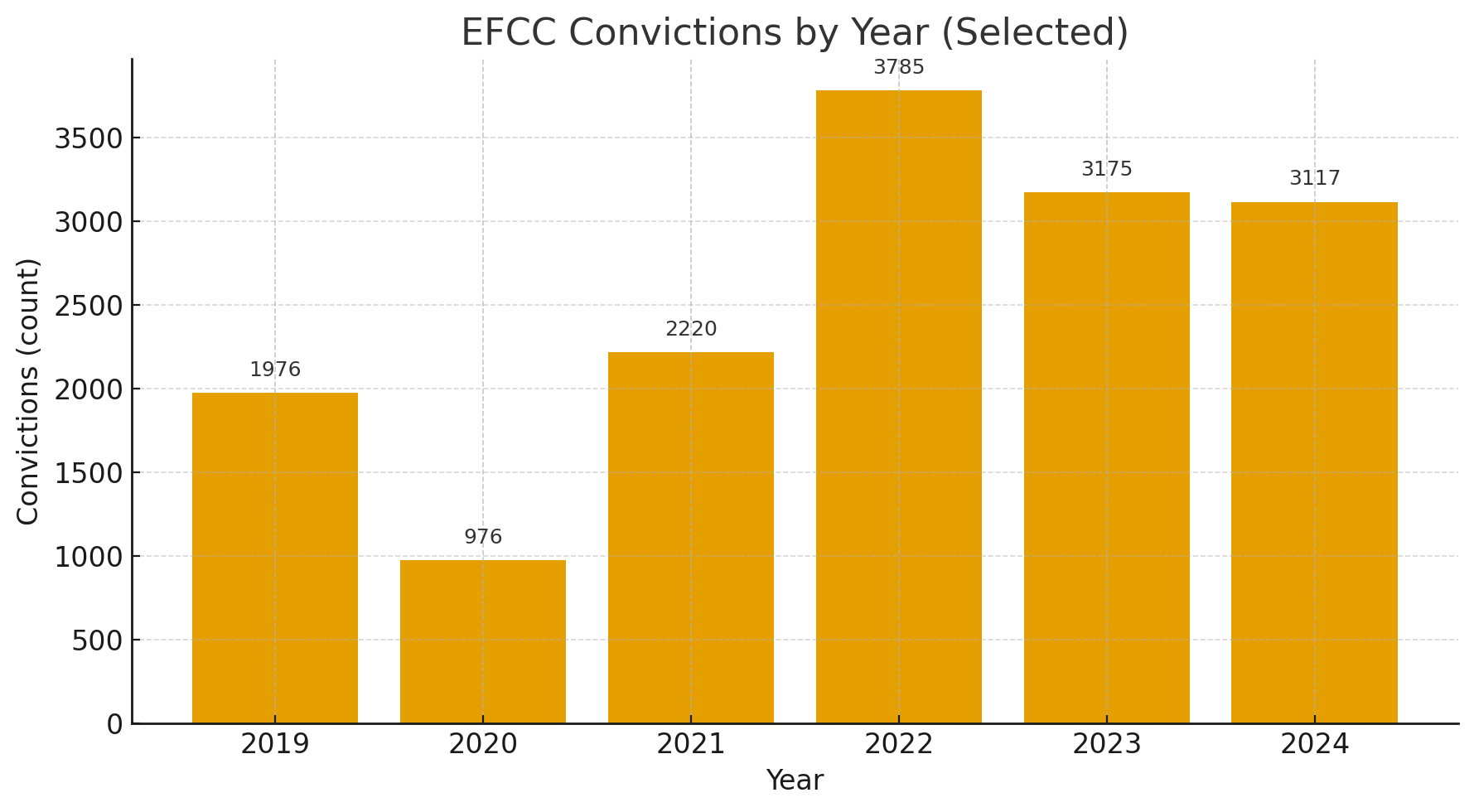
EFCC convictions by year chart
EFCC convictions have risen sharply since 2019; however, bulk totals include thousands of low-value cybercrime cases, masking the completion deficit in PEP matters.

While Nigerian anti-corruption agencies have reported impressive conviction figures, a closer look reveals a nuance regarding high-profile matters.

EFCC Conviction Trends:

2019: 1,976 convictions.

2021: 2,220 convictions.

2022: 3,785 convictions (record high).

2023: 3,175 convictions.

2024: 3,117 convictions nationwide. The Commission reported over 4,000 convictions and nearly $500 million recovered in its most successful 12-month period to March 2025.

Context & Caveat: These totals aggregate all cases, including thousands of lower-value cybercrime (“yahoo-yahoo”) matters. High-profile PEP cases form a small fraction, consume disproportionate resources, attract sophisticated defenses, and have significantly lower completion rates. An independent analysis found a conviction rate of approximately 19% for EFCC cases between 2019 and 2023, suggesting a story of scale rather than necessarily quality for top-tier cases.

ICPC Output: ICPC recorded 80 convictions in 2023, alongside 2,229 investigations and 261 asset recoveries. ICPC’s mandate leans more towards policy integrity and systems reviews, resulting in naturally lower case volumes compared to EFCC.

Perceptions of Corruption: Despite the rising conviction numbers, Nigeria’s perceived integrity remains stubbornly low. Transparency International’s Corruption Perception Index (CPI) for 2024 scored Nigeria 26/100, ranking it 140 out of 180 countries, indicating a persistent credibility gap between enforcement volume and public perception.

Conclusion: Conviction totals should be viewed cautiously; the quality, seniority of the defendant, recovery of proceeds, and appellate durability matter more than raw counts when assessing elite accountability.

IV. Landmark Prosecutions (1999–2025): Cases, Outcomes, and Lessons

High-profile cases often serve as barometers for the effectiveness and fairness of Nigeria’s justice system.

Early Post-Transition Cases (Signals & Compromises):

IGP Tafa Balogun (2005): The former Inspector-General of Police pleaded guilty, received a six-month sentence, and had assets seized. This marked a watershed first conviction of a nationally prominent figure, but the short custodial term fostered perceptions of leniency.

Gov. Lucky Igbinedion (2008): A plea agreement resulted in a ₦3.5 million fine, asset forfeitures, and refunds, sparking public outrage over proportionality and becoming an archetype of “elite-friendly bargaining”.

Chief Bode George (2009): His conviction was quashed by the Supreme Court, which ruled that “contract-splitting” was not a known offense at the time. This case highlighted issues with charge-drafting and legality defects.

Governors, Ministers & Agency Heads (Mixed Results):

James Ibori (Delta State): Nigerian proceedings faltered, but a UK prosecution secured a 2012 conviction and ongoing confiscation orders, with £4.2 million repatriated to Nigeria in 2021. The UK track proved more decisive, underscoring the role of international cooperation.

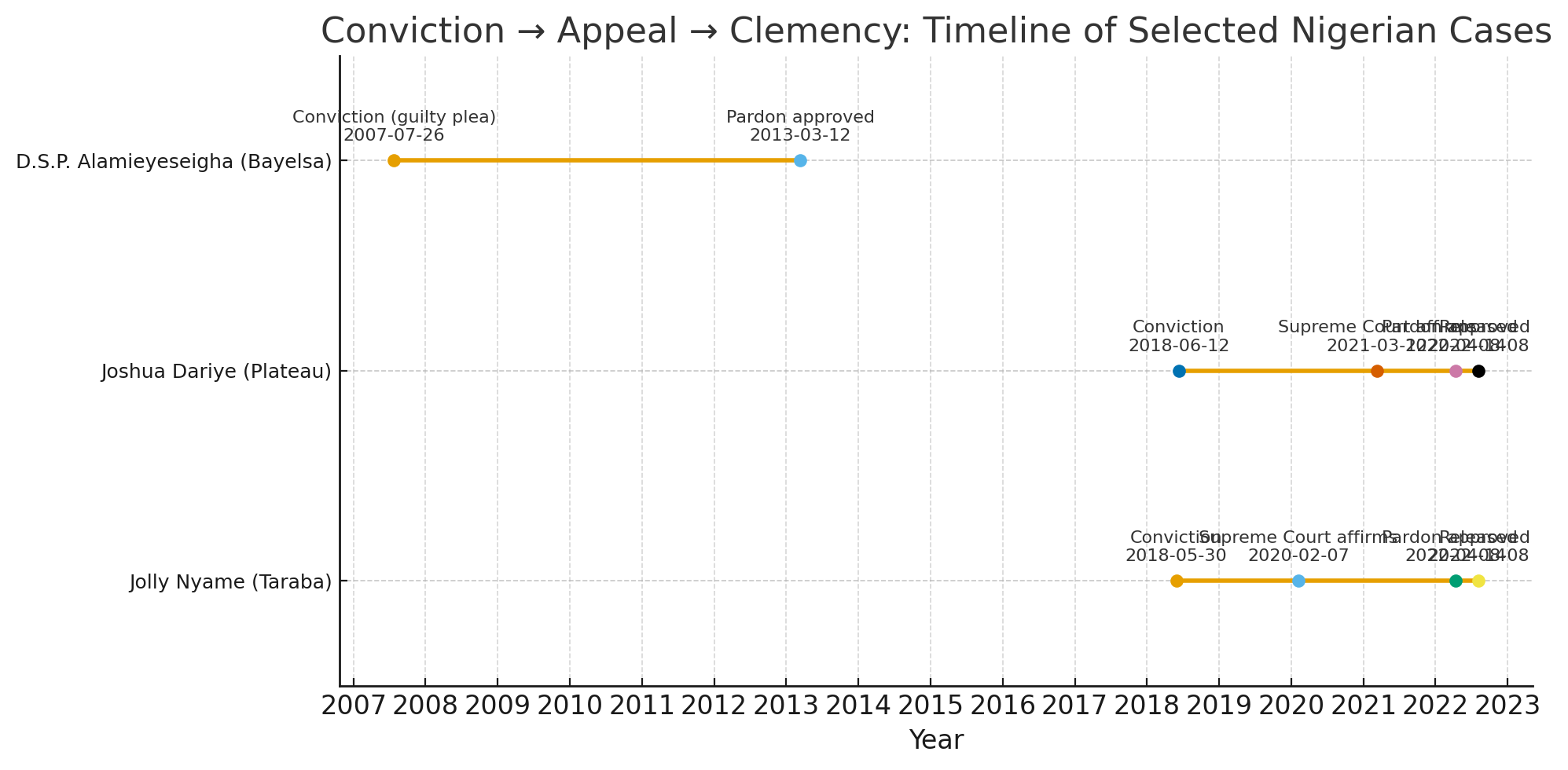
Joshua Dariye (Plateau) & Jolly Nyame (Taraba): Both former governors were convicted on corruption charges, with their convictions affirmed by the Supreme Court (Dariye in March 2021, Nyame in February 2020). However, they were granted presidential pardons in April 2022 and released in August 2022. This move drew widespread criticism for undermining deterrence and anti-graft credibility.

Orji Uzor Kalu (Abia): His 2019 conviction was voided in 2020 by the Supreme Court (Udeogu v. FRN) because the trial judge had been elevated to the Court of Appeal mid-way, making his return to conclude the trial impermissible under ACJA s.396(7). The 12-year megatrial was reset to zero, illustrating how a single procedural point can derail a marquee case and how litigation over a retrial can persist for years.

Abdulrasheed Maina (PRTT): His 2021 conviction (eight-year sentence) for N2.1 billion pension fraud was affirmed by the Court of Appeal in May 2023. This case serves as a counter-example where a high-value matter reached durable finality, with courts ordering final forfeiture of multiple properties in 2024.

Bukola Saraki (CCT assets case): Acquitted by the Supreme Court in 2018, which faulted the prosecution’s proof and procedural pathway. This case highlights that high-profile cases can collapse due to evidential weaknesses.

Farouk Lawan (fuel-subsidy probe): His conviction was affirmed by the Supreme Court in January 2024, and he completed his five-year term in 2024. This stands as a rare example of final accountability for a national figure.

Diezani Alison-Madueke: Charged in London in 2023 with bribery, her case underlines the centrality of mutual legal assistance and foreign forums for complex kleptocracy cases.

Godwin Emefiele (ex-CBN Governor): Faced multiple firearms, procurement, and other counts across various courts between 2023–2025. This is a classic example of multi-front litigation where interlocutory issues and serial amendments significantly slow substantive determination.

Yahaya Bello (ex-Kogi Governor): Faced a 19-count N80.2 billion money-laundering trial which opened in early 2025, after significant logistical and medical-leave skirmishes. The episode spotlights execution challenges when politically powerful defendants resist legal process.

Nnamdi Kanu (IPOB): On December 15, 2023, the Supreme Court restored terrorism charges and ordered his trial to continue. Since then, the Federal High Court has repeatedly denied bail and pressed for a speedy hearing. This national-security prosecution illustrates the judiciary’s use of ACJA’s speed tools.

Binance / Tigran Gambaryan: Nigeria brought money-laundering and tax-evasion actions in 2024. By October 2024, charges against the detained Binance executive were dropped, citing health and diplomatic considerations, while cases against the company persist.

Currency/Naira-Abuse Crackdown (Celebrity Defendants): EFCC has pursued cash-spraying and naira-mutilation cases, such as that of social media celebrity Bobrisky (six months’ imprisonment in April 2024), to signal behavioral change. These cases are high-profile due to publicity, not monetary value, and tend to conclude quickly.

VII. Presidential Pardons in Corruption Cases: Mercy or Impunity?

Nigeria corruption pardons timeline (Alamieyeseigha 2013; Nyame & Dariye 2022)
Timeline of controversial presidential pardons in corruption cases and their impact on deterrence.

Issue: When does a constitutionally valid grant of clemency, especially to convicted public officers, undercut Nigeria’s anti-graft policy rather than reinforce justice?

Rule:

Constitutional Source: Section 175 of the 1999 Constitution empowers the President to grant pardons, commute, or remit sentences after consultation with the Council of State. Crucially, the text does not publish substantive criteria (e.g., age, health, restitution) for exercising this mercy.

Comparative Guideposts: Other common-law jurisdictions offer varying approaches to presidential clemency:

United Kingdom: Royal Prerogative of Mercy is executive, but decisions face limited judicial review, and transparency is a recurring policy question.

United States: Article II clemency is broad, but the Department of Justice operates published standards (e.g., post-conviction conduct, seriousness, time elapsed) for advising the President.

South Africa: Section 84(2)(j) empowers presidential pardons, requiring the process to be rationally related to its purpose, including appropriate consultation.

India: Articles 72/161 clemency is reviewable on limited grounds (e.g., mala fides, irrelevant factors).

Application:

Case Studies: What Nigeria Actually Did—and How the Public Read It

Jolly Nyame (Taraba): Convicted in May 2018 (12 years, affirmed by Supreme Court in Feb 2020), he was pardoned by the Council of State on April 14, 2022, and released in August 2022.

Joshua Dariye (Plateau): Convicted in June 2018 (10 years, affirmed by Supreme Court in March 2021), he was also pardoned on April 14, 2022, and released in August 2022.

D.S.P. Diepreye Alamieyeseigha (Bayelsa): Convicted on a guilty plea in July 2007 (with asset forfeiture), his pardon in March 2013 drew strong domestic and international criticism.

Public Backlash & Deterrence Signal: All three acts of clemency were legally valid under Section 175, but the public optics were damaging. Civil society groups and commentators framed the 2022 pardons as an anti-deterrent signal, especially after years of litigation that resulted in final Supreme Court outcomes. While officials cited humanitarian grounds (age/health), the absence of published criteria or reasons made the decisions appear political rather than principled.

Policy Tension: Nigeria’s anti-graft agencies achieve sustained conviction totals, but elite-level clemency, particularly post-appeal, creates a significant gap between enforcement effort and perceived accountability. Unlike jurisdictions that publish clemency standards, Nigeria’s substantive standards remain opaque.

Conclusion (A Workable Framework for Principled Mercy): To ensure that clemency reinforces rather than undermines anti-graft efforts, Nigeria could adopt a framework with publishable criteria and a light-touch review mechanism.

Publishable Criteria (What to Adopt):

Restitution & Disgorgement First: Full or substantial repayment/forfeiture as a precondition for pardon in corruption cases, mirroring best practices in the US and South Africa.

Age/Health Thresholds with Evidence: Require independent medical certification, explicitly explaining how the public interest in humane treatment outweighs deterrence, especially after a final appeal.

Time-Served & Conduct: Stipulate minimum elapsed time and a spotless custodial record, with structured consideration of rehabilitation and public remorse.

Equal-Treatment Screen: Demonstrate parity with similarly-situated, non-PEP applicants to rebut selectivity claims.

Reason-Giving & Publication: A short public statement of reasons (with appropriate redactions for privacy) to legitimize outcomes and enable informed critique, as seen in UK transparency debates.

Review Mechanism (Light-Touch, Constitutional): The President’s power should remain intact, but an internal record should demonstrate how the decision met published criteria and Council of State advice. Courts in comparable systems review for rationality and relevant considerations (e.g., South Africa’s Albutt, UK’s ex p. Bentley, India’s Epuru Sudhakar), a process-rationality standard Nigeria could emulate without constitutional amendment.

Visual Add-ons: (As requested, these would typically be included in a publish-ready article)

Timeline Graphic: A visual representation of the conviction, appeal, and clemency dates for cases like Nyame, Dariye, and Alamieyeseigha.

Comparative Table: A table outlining common-law pardon frameworks, comparing Nigeria with the UK, US, South Africa, and India on sources of power, advisory processes, published criteria, and judicial review.

VIII. What Works: Success Patterns

Despite the challenges, certain patterns lead to more durable outcomes in high-profile prosecutions:

Tight Charges + Specialist Trial Management: Cases like Abdulrasheed Maina and Farouk Lawan demonstrate that narrow indictments, corroborated evidence, and rigorous enforcement of ACJA timelines result in convictions that survive appeal and lead to forfeitures.

Cross-Border Cooperation: The UK Ibori proceedings and recent foreign asset orders highlight the value of Mutual Legal Assistance Treaties (MLATs), proactive liaison with foreign agencies, and early parallel financial-intelligence work.

Judiciary Insistence on Speed and Process: In the Nnamdi Kanu case, despite its political sensitivities, the Supreme Court ordered the trial to continue, and the Federal High Court denied bail while directing accelerated hearing. This shows that courts can enforce ACJA’s speed tools even amid polarization.

IX. Reform Agenda: Practical and Lawful Solutions

To bridge the gap between legal provisions and credible outcomes, a multi-faceted reform agenda is essential:

Legislative Clean-up of ACJA: Clarify or replace the controversial s.396(7) pathway with constitution-proof arrangements, such as full de novo rules with strict time caps, or panelized trials to mitigate elevation risk.

Appellate Case-Management: Introduce fast-track lists for interlocutory appeals in corruption, terrorism, and market-integrity matters, with tight briefing schedules and consolidation of appeals from the same trial.

Prerogative of Mercy Guidelines: Establish transparent, criteria-bound rules for corruption-case pardons (e.g., age/health criteria, post-conviction compliance, restitution), with public reasons provided, to preserve legitimacy.

Data Transparency: Publish PEP-case dashboards (showing charges, next dates, elapsed time, appeal status) separate from bulk cybercrime statistics, allowing the public to track progress on high-impact matters.

Asset Recovery First: Lean harder on POCA 2022’s non-conviction-based recovery mechanisms in parallel with trials, ensuring that restitution is not solely dependent on trial length.

Specialist Circuits & Witness Support: Expand specialist rosters or practice directions (like the Federal High Court’s corruption trial directions) and strengthen witness protection and logistics.

National Charging & Plea-Bargain Guidelines: Develop national guidelines for corruption cases, with judicial sign-off linked to restitution ratios and proportionality to prevent public backlash.

Mandatory Case Timelines for VIP Matters: Implement strict timelines under ACJA practice directions, with sanctions for dilatory tactics, and tighter limits on interlocutory appeals until final judgment.

Forensics & Disclosure Upgrades: Allocate ring-fenced budgets for forensic accounting, e-discovery, chain-of-custody tools, and protected expert-witness panels.

Transparent Asset-Return Frameworks: Establish clear frameworks for the return of repatriated assets, including beneficiary-state routing and project-level disclosure dashboards, to build public trust.

Communications Code for Investigators/Prosecutors: Implement clear protocols forbidding public naming until proper service, preventing prejudicial pressers, and imposing contempt triggers for violations, reflecting judicial reprimands against “media trials”.

Election-Period Firewalls: Introduce bipartisan oversight of vote-buying task forces and joint reporting between EFCC, INEC, and civil society to reduce “weaponization” claims.

Legal Tools to Resist Weaponisation: Counsel can leverage the abuse-of-process doctrine (for multiplicity, forum shopping, publicity prejudice), challenge defective service and warrant practice, enforce fundamental rights against unlawful remand/holding charges, and scrutinize the Attorney-General’s nolle prosequi power against public interest. International standards (e.g., UN Guidelines on Prosecutors) can also serve as persuasive benchmarks.

X. Conclusion: The Path to Credible Accountability

Nigeria has made significant strides in its anti-corruption and serious-crime fight since 1999, establishing modern laws and institutions that have led to increasing conviction totals and notable successes like the Maina and Farouk Lawan cases. However, at the apex of the justice system, procedure, politics, and proof still disproportionately decide outcomes. The Supreme Court’s decisions in cases like Nnamdi Kanu (insisting on speed) and Orji Kalu (correcting procedural errors) demonstrate the judiciary’s potential, but cases can still crumble on fixable technicalities or be undone by political clemency.

The path to credible high-profile accountability is clear: it requires bullet-proof procedure, evidence that survives appeal, transparent decisions on mercy, and disciplined communication. By implementing the outlined reforms – from specialized courts and robust forensics to principled plea bargains and transparent asset returns – Nigeria can transform high-profile prosecutions from perceived political theatre into reliable instruments of the rule of law. The goal is not just to win cases, but to be seen to win them fairly, consistently, and without bias, across all parties, regions, and classes.

References

  1. Constitution of the Federal Republic of Nigeria 1999 (as amended), sections 174, 175, 308.
  2. Administration of Criminal Justice Act, 2015 (ACJA), especially ss. 306, 396.
  3. Money Laundering (Prevention and Prohibition) Act, 2022.
  4. Proceeds of Crime (Recovery and Management) Act, 2022.
  5. Terrorism (Prevention and Prohibition) Act, 2022.
  6. EFCC (Establishment) Act, 2004; ICPC Act, 2000.
  7. Udeogu v. Federal Republic of Nigeria (2020) 5 NWLR (Pt. 1716) 1 (SC) — effect of elevation of trial judge under s.396(7) ACJA; impact on Orji Uzor Kalu’s conviction.
  8. Jolly Nyame v. FRN (2020) 9 NWLR (Pt. 1730) 353 (SC); Joshua Dariye v. FRN (2021) 15 NWLR (Pt. 1798) 1 (SC) — affirming convictions before 2022 pardons.
  9. FRN v. James Ibori & Ors (Southwark Crown Court, 2012) — UK conviction and confiscation; repatriation of £4.2m to Nigeria in 2021.
  10. Saraki v. FRN (2018) 16 NWLR (Pt. 1646) 433 (SC) — acquittal on CCT assets declaration charges.
  11. Abdulrasheed Maina v. FRN (CA/A/29C/2022, 30 May 2023) — conviction affirmed; subsequent final forfeiture orders (2024).
  12. Farouk Lawan v. FRN (SC.881/2022, 19 January 2024) — Supreme Court affirmation of conviction.
  13. Supreme Court (15 December 2023) in Nnamdi Kanu — restoration of terrorism trial; directive for accelerated hearing.
  14. Transparency International, Corruption Perceptions Index 2024 — Nigeria score 26/100; rank 140/180.
  15. POCA 2022 & non-conviction-based forfeiture: Federal High Court practice directions and recent final forfeiture rulings (2023–2024).

Need focused legal insight or representation?

Our team at 1st Attorneys advises on anti-corruption compliance, high-stakes investigations, asset recovery, public law litigation, and appellate strategy. Let’s help you move from controversy to credible outcomes.

]]>
https://1stattorneys.ng/articles/2025/08/30/high-prosecutions/feed/ 0
The Paradox of Knowledge, Power, and Influence: Why the Smartest Are Not Always in Control https://1stattorneys.ng/articles/2025/07/02/the-paradox-of-knowledge-power-and-influence-why-the-smartest-are-not-always-in-control/ https://1stattorneys.ng/articles/2025/07/02/the-paradox-of-knowledge-power-and-influence-why-the-smartest-are-not-always-in-control/#respond Wed, 02 Jul 2025 07:16:42 +0000 https://1stattorneys.com/articles/?p=4541

In a world driven by information, it’s tempting to believe that intelligence or knowledge naturally leads to success, wealth, and leadership. But real-life observation tells a very different story.

We often find that those who wield the most power; politicians, business magnates, or public figures  are not necessarily the most intelligent, knowledgeable, or wise. Meanwhile, those with deep intellectual insight, technical expertise, or profound moral understanding often remain on the margins of influence.

This reality raises a profound question: Why are knowledgeable people so often controlled or outmaneuvered by those with lesser insight? And why do those in positions of power routinely make decisions that fall short of improving lives, even when better options are known and available?

Let’s explore the layers of this paradox.

  1. The Myth of a Single Scale of Intelligence

Our society tends to glorify a narrow definition of intelligence — typically measured by academic qualifications, test scores, or technical expertise. But intelligence, in truth, is multifaceted:

  • Cognitive Intelligence (IQ) – analytical and abstract reasoning skills.
  • Emotional Intelligence (EQ) – self-awareness and the ability to manage relationships.
  • Social Intelligence – understanding group dynamics and navigating power structures.
  • Practical Intelligence – knowing how to get things done in real-world situations.
  • Persuasive Intelligence – the art of influence, manipulation, and communication.

Someone may possess a PhD in physics and still be naïve about how the world works. Conversely, someone with no formal education may know how to read people, build alliances, or mobilize a crowd — and thus, they often ascend to leadership.

  1. Influence Often Outranks Insight

People in power; especially in politics or business, often have less technical knowledge than those they govern. Yet they control, influence, and sometimes mislead experts and the public alike.

This happens because:

  • Control of information, not its accuracy, shapes public opinion.
  • Emotional appeal often trumps logical reasoning in mass communication.
  • Charisma and confidence often override credentials in leadership perception.
  • Power structures reward loyalty and ambition, not just brilliance.

Power does not necessarily seek the truth; it seeks to sustain itself. The wise may know the truth, but lack the platform, aggression, or manipulation skills to push it forward in competitive arenas.

  1. The Fallacy of Meritocracy in Wealth and Success

Contrary to the belief that hard work and intelligence lead to wealth, success is often determined by factors like:

  • Access to capital or opportunity
  • Strategic risk-taking
  • Timing and adaptability
  • Family connections or privilege
  • The ability to sell a product, a vision, or oneself

Many intelligent individuals struggle to succeed because they:

  • Overthink and under-act
  • Avoid political games and power struggles
  • Lack the social leverage to scale their ideas

Meanwhile, others less “qualified” thrive by mastering perception, relationships, and timing.

  1. Why Leaders Make Poor Decisions — Even When They Know Better

It’s frustrating to see leaders ignore wise counsel or fail to implement proven solutions. Often, this is not due to ignorance, but due to incentive structures:

  • Political decisions are guided by election cycles, not long-term thinking.
  • Lobbyists, donors, and interest groups influence outcomes behind closed doors.
  • Optics often matter more than effectiveness.
  • The status quo may be easier to defend than radical but needed reform.

Leaders may know better but act otherwise, because doing the right thing is not always aligned with staying in power.

  1. When Knowledge is Powerless

The ideal that “knowledge is power” is only partially true. In reality:

  • Knowledge without influence is often ignored.
  • Truth without narrative can be buried under noise.
  • Wisdom without courage stays locked in journals, libraries, or lectures.

The real world rewards those who can translate knowledge into action, and navigate the human systems of emotion, persuasion, and control.

Conclusion: Bridging the Divide

Understanding this paradox is the first step to changing it.

We need a world where:

  • Intelligence is valued alongside integrity and emotional maturity.
  • Structures reward competence over charisma.
  • Those with knowledge are empowered to act and those with power are held accountable to truth.

To make this shift, the “wise” must step into the messy world of action and influence. Knowledge must meet courage. Intelligence must merge with strategy. And wisdom must find a voice loud enough to rise above the noise.

Until then, we will continue to live in a world where those who know are governed by those who play the game better.


]]>
https://1stattorneys.ng/articles/2025/07/02/the-paradox-of-knowledge-power-and-influence-why-the-smartest-are-not-always-in-control/feed/ 0
Defections Without Ideology: What the APC Wave Reveals About Nigerian Politics https://1stattorneys.ng/articles/2025/06/15/defections-without-ideology-what-the-apc-wave-reveals-about-nigerian-politics/ https://1stattorneys.ng/articles/2025/06/15/defections-without-ideology-what-the-apc-wave-reveals-about-nigerian-politics/#respond Sun, 15 Jun 2025 20:06:26 +0000 https://1stattorneys.com/articles/?p=4500

In recent months, Nigeria has witnessed a fresh and growing wave of defections by prominent political figures into the All Progressives Congress (APC). From state governors and federal lawmakers to grassroots political influencers, the exodus from opposition parties into the ruling APC appears not just widespread but also strategic. While party-switching is not new in Nigeria’s political culture, the sheer frequency and momentum of recent defections have raised important questions about the health of the country’s democracy and the underlying motivations of its political class.

Power, Privilege, and Political Survival

At the heart of most defections lies the pursuit of political survival and access to state power. In Nigeria’s heavily centralized political system, control of the federal government confers enormous influence over security agencies, budget allocations, patronage networks, and appointments. For many politicians, aligning with the ruling party—currently the APC—is a calculated move to remain relevant, avoid political isolation, and secure their personal and political interests.

The APC’s dominance in the National Assembly and its control of key states make it a magnet for those who view political affiliation primarily as a means of survival rather than ideological alignment. Being in opposition, particularly in a state controlled by the APC, often translates to limited access to state resources, marginalization in federal allocations, and a more challenging electoral path.

A Democracy without Ideology

A major driver of defections is the lack of ideological depth in Nigeria’s political party system. The lines separating the APC, the Peoples Democratic Party (PDP), the Labour Party, and other political entities are often blurred. Beyond campaign slogans and election manifestos, most parties do not offer distinct philosophies or long-term policy visions.

This absence of ideological grounding enables a fluid and often opportunistic movement of politicians across party lines. For many, a political party is merely a platform to achieve electoral success. Loyalty to principles takes a back seat when opportunities for appointments, contracts, or political protection are perceived to be greater in another party.

Pre-2027 Positioning

Another strong undercurrent driving the defections is the anticipation of the 2027 general elections. Politicians are already aligning themselves for future contests—whether for the presidency, governorships, Senate seats, or local government leadership. The APC, being the ruling party, is viewed by many as the most strategic base from which to launch such ambitions.

By joining the APC now, defectors hope to build early alliances, curry favor with the party hierarchy, and increase their chances of being selected as candidates during primaries. For those who lost out in previous elections, it is also a means to reinvent themselves and return to public office through a potentially more favorable platform.

Collapse of Internal Democracy in Opposition Parties

The implosion of internal democracy within opposition parties has also driven many into the arms of the APC. The PDP, once Nigeria’s dominant political party, has been racked by internal disputes, leadership tussles, and factionalism. The Labour Party, despite its recent electoral resurgence, has struggled with credibility, structural cohesion, and coordinated opposition.

When internal crises become irreconcilable, defection becomes a practical, if cynical, escape route. Rather than stay to reform their parties, many politicians prefer to abandon ship and join the more cohesive APC machinery.

Defection as a Legal and Ethical Loophole

In theory, Nigeria’s Constitution provides some checks against defections, especially for lawmakers who switch parties without a justifiable cause. However, in practice, enforcement is lax, and defectors frequently cite “division” within their parties as a legal cover. This loophole, combined with the reluctance of party leaders to challenge powerful defectors, has effectively normalized defection as an accepted part of the political process.

The EFCC and the Politics of Prosecution

There is also a more controversial angle: defection as a shield from prosecution. Critics have pointed to a pattern where politicians under investigation by the Economic and Financial Crimes Commission (EFCC) suddenly find refuge in the APC—and, curiously, face reduced scrutiny thereafter. While the APC has denied using its platform as a sanctuary for the corrupt, the optics have not been favorable.

The perception that joining the ruling party provides a form of immunity—whether real or imagined—undermines public trust in the justice system and fuels the belief that the fight against corruption is selective and politicized.

A Troubling Trend for Democracy

Ultimately, the wave of defections to the APC is a symptom of deeper issues within Nigeria’s democratic experiment. The absence of strong institutions, the dominance of political godfathers, the fragility of party structures, and the overwhelming focus on personal gain over public service have all combined to produce a political culture where loyalty is fleeting and principles are expendable.

While the APC may celebrate these defections as signs of strength and popularity, the broader implication is a weakening of opposition, reduced political competition, and the erosion of accountability. Democracy thrives on the presence of vibrant, principled alternatives—not a revolving door of opportunism.

Conclusion

Until Nigeria’s political parties evolve into truly ideological, policy-driven entities with internal democracy and accountability, defections will remain a recurring feature of its political landscape. And as long as power remains centralized and transactional, politicians will continue to treat party membership as a tool for advancement, not a commitment to serve.

The challenge now is for citizens, civil society, and reform-minded leaders to demand better: parties that stand for something, and politicians who stay for something.

]]>
https://1stattorneys.ng/articles/2025/06/15/defections-without-ideology-what-the-apc-wave-reveals-about-nigerian-politics/feed/ 0
Can Nigeria Become Un-Corrupt? https://1stattorneys.ng/articles/2025/05/28/can-nigeria-become-un-corrupt/ https://1stattorneys.ng/articles/2025/05/28/can-nigeria-become-un-corrupt/#respond Wed, 28 May 2025 07:07:03 +0000 https://1stattorneys.com/articles/?p=4469

Corruption in Nigeria has long been a pervasive and deeply rooted challenge, casting a shadow over governance, economic growth, and public trust. From inflated contracts and embezzled public funds to nepotism and electoral malpractice, corruption permeates virtually every sector. Yet the question remains: Can Nigeria become un-corrupt? While the journey is long and difficult, the answer is not an outright “no.” With sustained reforms, strong institutions, and collective national will, Nigeria can significantly reduce — if not entirely eliminate — corruption.


Understanding the Depth of the Problem

To envision an un-corrupt Nigeria, we must first understand the scale of the problem. Transparency International’s Corruption Perceptions Index consistently ranks Nigeria poorly. Reports of missing billions in public funds are routine, and corruption has become almost normalized in everyday life — from police checkpoints to civil service offices.

But corruption in Nigeria is not just about stolen money. It is about broken systems — weak institutions, lack of accountability, and a culture where the powerful operate above the law.


Is It Possible to Become “Un-Corrupt”?

Strictly speaking, no country in the world is completely un-corrupt. However, several countries have transitioned from being deeply corrupt to being models of transparency and good governance — examples include Singapore, Georgia, and Rwanda. These countries didn’t rely on wishful thinking; they relied on strategic, long-term structural reforms.

So, can Nigeria follow suit? Yes — but only if certain key conditions are met.


What Must Change?

1. Institutional Reforms

The biggest weapon against corruption is a strong institution. Nigeria must strengthen the independence, capacity, and integrity of its judiciary, anti-graft agencies (like the EFCC and ICPC), and public audit institutions. These bodies must be shielded from political interference and equipped to act decisively.

2. Leadership by Example

Corruption often flows from the top. When leaders are corrupt or indifferent to corruption, it gives tacit approval to everyone else. If, however, leaders at all levels — federal, state, and local — lead by example, enforce transparency, and punish offenders, it sends a powerful message.

3. Civic Education and Cultural Reorientation

Corruption is not just a political issue — it’s cultural. Many Nigerians see bribery or “settlement” as normal. We must re-educate ourselves about the cost of corruption and redefine our national values around integrity, honesty, and justice.

4. Digital Governance

Technology can be a powerful tool to reduce human contact in public service delivery — thereby minimizing opportunities for graft. E-governance systems, digital payment platforms, procurement tracking, and automated public sector processes can dramatically reduce corruption.

5. Youth Engagement

Nigeria’s youthful population must not inherit the corrupt norms of the past. Instead, they must be empowered to demand accountability, run for office, and reshape Nigeria’s future. Programs that encourage youth participation in governance and entrepreneurship can redirect energies from illicit activities to constructive nation-building.


A Glimpse of Hope

There have been positive developments. The Treasury Single Account (TSA), Bank Verification Number (BVN), and whistleblower policy have exposed and blocked numerous avenues of corruption. Civil society groups and investigative journalists are playing an increasingly active role in exposing graft. Court decisions, though inconsistent, are beginning to show signs of strength. These are not silver bullets, but they are steps in the right direction.


Conclusion: The Road Ahead

Becoming “un-corrupt” is not a destination — it is a continuous process. For Nigeria, that process will involve tearing down the old order and building a new system of values, laws, and practices. It will involve sacrifice, courage, and persistence. But if other nations have done it, Nigeria can too.

It will take a government willing to lose popularity, a citizenry ready to speak up, and a judiciary brave enough to stand firm. Nigeria may not become completely un-corrupt, but it can certainly become a nation where corruption is the exception — not the norm.

And that would be a transformation worth striving for.

]]>
https://1stattorneys.ng/articles/2025/05/28/can-nigeria-become-un-corrupt/feed/ 0
Nigeria and the Curse of Institutionalised Corruption https://1stattorneys.ng/articles/2025/05/28/nigeria-and-the-curse-of-institutionalised-corruption/ https://1stattorneys.ng/articles/2025/05/28/nigeria-and-the-curse-of-institutionalised-corruption/#respond Wed, 28 May 2025 07:01:53 +0000 https://1stattorneys.com/articles/?p=4464

In Nigeria, corruption is not merely a vice—it is a way of life, embedded deep into the operating systems of state. It is institutionalised, sustained by complicit actors across all branches and levels of government, and normalized in a way that has numbed the collective conscience of a nation. From the police force to the judiciary, anti-corruption bodies to schools, hospitals, customs, and public procurement offices, corruption is both the thread and the fabric of everyday governance. What began as a cancerous cell in isolated corners of government has metastasised into the DNA of Nigeria’s institutions.

The Nigerian Police Force, one of the most visible arms of the state, exemplifies this rot. A force meant to enforce the law has long abandoned that mandate in favor of extortion and brutality. From roadside checkpoints where officers shamelessly demand “something for the boys,” to police stations where bail is sold to the highest bidder despite constitutional provisions to the contrary, the public has come to accept this dysfunction as normal. The disbanded SARS unit, whose reign of terror sparked the #EndSARS movement in 2020, was a chilling symbol of institutionalised violence and corruption. Investigations revealed officers who not only extorted citizens but engaged in torture and extra-judicial killings. Few were held accountable. This impunity reinforces the idea that police uniforms are licenses for predation, not protection.

When one turns to the Economic and Financial Crimes Commission (EFCC), the very agency designed to fight financial crimes, the picture is not more hopeful. Once celebrated for its aggressive pursuit of corrupt officials, the EFCC has, over time, become entangled in its own scandals. The arrest and investigation of its former acting chairman, Ibrahim Magu, in 2020 for alleged mismanagement of seized assets and over ₦500 billion in unaccounted funds, sent shockwaves across the country. Allegations that the EFCC serves more as a political weapon than an impartial enforcer of justice have eroded its credibility. Selective prosecution and the safe passage often granted to politically connected looters have turned anti-corruption into a game of convenience.

The judiciary, which should be the last hope of the common man, often serves as the final nail in the coffin of justice. With judges accused of collecting bribes in dollars and delivering judgments that defy logic, Nigeria’s courts have become theatres where justice is auctioned. In 2016, a dramatic raid by the Department of State Services uncovered millions in cash from the homes of senior judges. Though some were dismissed or retired, others quietly returned to the bench, proving that even the appearance of accountability can be faked. The case of former Chief Justice of Nigeria, Walter Onnoghen, found guilty of failing to declare suspicious assets, further highlighted the vulnerability of the judiciary to internal compromise and external manipulation.

Among politicians, corruption is not a scandal—it is standard operating procedure. The scale of looting is staggering. Former Petroleum Minister Diezani Alison-Madueke is alleged to have stolen over $2.5 billion through phantom contracts and kickbacks. James Ibori, former Governor of Delta State, was celebrated at home even after being convicted in the UK for laundering over £50 million of state funds. Nigeria continues to recover stolen billions linked to the late General Sani Abacha, decades after his death—funds that continue to turn up in Swiss and American banks. This recycled kleptocracy, in which looters are reabsorbed into public life through political realignments or plea bargains, feeds the perception that crime does pay—as long as you’re powerful enough.

Yet, the real engine of corruption is the civil service—the quiet and seemingly faceless bureaucracy that controls government records, procurement, and payment systems. Here, contracts are inflated beyond imagination, ghost workers haunt payrolls, and entire budgets vanish through “virement” and creative accounting. The case of Abdulrasheed Maina, who embezzled billions in pension funds and was secretly reinstated into the civil service while a fugitive, is an emblem of the impunity civil servants enjoy. This group forms the unbreakable link between corrupt politicians and the misappropriated public funds that never reach their intended destinations.

In customs and border control, bribery and smuggling are institutionalised. Import duties are manipulated, prohibited items find their way into the country, and underhanded deals are struck in plain sight. A container flagged for red inspection today could be cleared tomorrow with the right “appreciation.” The loss in government revenue is colossal, and the long-term effects are even more damaging—cheap substandard goods flood the markets while local industries collapse.

In public procurement, the rot is mechanised. Contracts are awarded not based on capacity or quality but on kickbacks and political loyalty. Roads are constructed at triple the standard rate and still fall apart after the first rains. School buildings are commissioned with much fanfare, yet the classrooms remain empty, lacking furniture and teachers. Entire budgets can be swallowed by feasibility studies that never see execution. The public procurement system in Nigeria, although governed by clear legal frameworks, is one of the most manipulated spaces in government.

The education sector has not been spared. From inflated contracts to construct classrooms, to the buying and selling of grades in secondary schools and universities, corruption here is breeding the next generation of ethically bankrupt citizens. Admission rackets, “sorting” of lecturers for grades, and diversion of intervention funds by school administrators are all part of the dismal reality.

In healthcare, corruption kills—literally. Funds meant for primary health care centres are diverted, leading to understaffed and ill-equipped hospitals. Drugs are stolen from government warehouses and sold in open markets. In 2018, the Nigerian Senate uncovered a ₦10 billion scandal involving the National Health Insurance Scheme, where funds meant to provide health coverage were misused or simply vanished. For the average Nigerian, this means suffering in silence, or paying out-of-pocket for services that were already paid for by the state.

What is particularly frightening about this entrenched corruption is that it is often not seen as a problem by those within the system—it is seen as entitlement. A cut. A share. A reward for enduring poor salaries and inadequate infrastructure. The average civil servant, customs officer, or local government chairman does not see his cut as theft, but as survival.

And so, Nigeria’s institutions, rather than acting as bulwarks against corruption, have become factories for its manufacture and distribution. This is why anti-corruption campaigns, while loud in rhetoric, often fail—they are attempting to use corrupted tools to repair corruption. It is akin to curing a poisoned patient with the same toxin that caused their illness.

The question is no longer whether Nigeria is corrupt, but whether it can be un-corrupted. This will not happen through slogans or selective scapegoating. It will require a systemic purge. It will require automated and digitised systems that remove human discretion. It will require strengthening the independence of the judiciary, protecting whistleblowers, enforcing asset declarations, and making transparency the norm, not the exception. Most importantly, it will require that corruption ceases to be a bipartisan enterprise tolerated by the elite.

Until this happens, Nigeria will remain a nation betrayed by its own institutions—trapped in a loop where looters are celebrated, and integrity is punished. A nation where the gatekeepers have become the looters, and where hope, like public funds, is constantly stolen.


]]>
https://1stattorneys.ng/articles/2025/05/28/nigeria-and-the-curse-of-institutionalised-corruption/feed/ 0
Evaluating Nigerian Politicians: People-Oriented or Self-Seeking? https://1stattorneys.ng/articles/2025/05/27/evaluating-nigerian-politicians-people-oriented-or-self-seeking/ https://1stattorneys.ng/articles/2025/05/27/evaluating-nigerian-politicians-people-oriented-or-self-seeking/#respond Tue, 27 May 2025 15:11:49 +0000 https://1stattorneys.com/articles/?p=4455

The question of whether Nigerian politicians are people-oriented or self-seeking is both a legal and moral inquiry with profound implications for democratic governance, rule of law, and socio-economic development. This article examines the conduct of political actors in Nigeria through the lens of constitutional obligations, public accountability, and democratic expectations, ultimately offering a balanced perspective grounded in observable realities.


1. Constitutional and Legal Obligations of Political Officeholders

The Constitution of the Federal Republic of Nigeria, 1999 (as amended), clearly outlines the responsibilities of public officers. Section 14(2)(b) affirms that:

“The security and welfare of the people shall be the primary purpose of government.”

Furthermore, the Code of Conduct for Public Officers, enshrined in the Fifth Schedule of the Constitution and enforced by the Code of Conduct Bureau and Tribunal, imposes standards of integrity, transparency, and accountability.

In this regard, politicians are not only political actors but fiduciaries — stewards entrusted with public resources for the common good. A deviation from this fiduciary duty transforms political leadership into a platform for personal gain, which, in turn, erodes the public trust and undermines democratic governance.


2. Evaluative Criteria: People-Oriented vs. Self-Seeking Leadership

a. Policy Orientation

A people-oriented politician is proactive in initiating policies that improve the quality of life of citizens — in education, healthcare, infrastructure, security, and economic development. By contrast, self-seeking politicians focus on policies or budgets that directly or indirectly benefit themselves, their business interests, political sponsors, or ethnic coalitions.

b. Transparency and Accountability

Public officers are required under the Freedom of Information Act, 2011 and various anti-corruption laws to conduct public affairs with transparency. Unfortunately, many Nigerian politicians avoid scrutiny, resist legislative oversight, and often violate procurement and financial regulations. This suggests a tilt toward personal rather than public interest.

c. Engagement with the Electorate

A genuine, people-oriented leader maintains continuous engagement with constituents, listens to their needs, and provides feedback. Conversely, self-seeking politicians often reappear only during election cycles, engage in vote-buying, and use patronage systems to retain power.

d. Wealth Accumulation and Lifestyle

One of the clearest indicators of self-seeking leadership is the unexplained accumulation of wealth. Politicians whose wealth exponentially grows during or after public office, often without credible sources of income, are presumed to have enriched themselves through abuse of office — a breach of public trust under Nigerian law.

e. Legacy and Impact

The lasting impact of a politician’s tenure can speak volumes. People-oriented politicians leave a legacy of institutions, laws, and infrastructure. Those who prioritize self-interest often leave behind abandoned projects, debts, and disillusioned citizens.


3. Contemporary Nigerian Political Landscape: An Unsettling Diagnosis

While it is important to avoid sweeping generalizations, empirical evidence and public sentiment indicate that a majority of Nigerian politicians exhibit self-seeking tendencies. Notable instances of corruption — from the fuel subsidy scam to pension fraud and electoral malpractices — illustrate a pattern of governance that prioritizes personal interest over national development.

That said, Nigeria has witnessed outliers — public figures who have shown genuine commitment to public service. For instance, Mr. Peter Obi (former Governor of Anambra State) is often lauded for his prudent financial management and people-centric policies. Similarly, historical figures such as Chief Obafemi Awolowo are remembered for visionary leadership, particularly in education and healthcare.


4. Legal and Civic Pathways to Reform

To reverse the trend of self-seeking leadership and encourage people-oriented governance, the following mechanisms must be strengthened:

  • Enforcement of Anti-Corruption Laws: Agencies like the EFCC and ICPC must act independently and prosecute political officeholders without fear or favour.

  • Civic Education and Electoral Reforms: Voters must be educated to vote based on issues, not ethnic or monetary incentives. Electoral laws should be enforced to penalize vote-buying and manipulation.

  • Judicial Independence: The judiciary must remain impartial and enforce the law, particularly in matters of election petitions, abuse of office, and asset declarations.

  • Constitutional Reforms: There is a need to restructure incentives and privileges attached to political offices to discourage office-seeking for personal enrichment.


Conclusion

The Nigerian political class stands at a crossroads. While some politicians have demonstrated that governance can be people-oriented, the prevailing culture still leans heavily toward self-interest. A combination of legal reform, institutional accountability, and civic responsibility is necessary to ensure that leadership in Nigeria genuinely serves the people, in accordance with constitutional ideals and democratic values.


]]>
https://1stattorneys.ng/articles/2025/05/27/evaluating-nigerian-politicians-people-oriented-or-self-seeking/feed/ 0
The Right of Nigerians to Criticize Their Government and Demand Accountability Introduction https://1stattorneys.ng/articles/2025/03/19/the-right-of-nigerians-to-criticize-their-government-and-demand-accountability-introduction/ https://1stattorneys.ng/articles/2025/03/19/the-right-of-nigerians-to-criticize-their-government-and-demand-accountability-introduction/#respond Wed, 19 Mar 2025 09:15:23 +0000 https://1stattorneys.com/articles/?p=4326

Introduction

Since gaining independence in 1960, Nigeria has experienced a complex interplay between governance and public criticism. Successive administrations have adopted varying approaches to address dissent, ranging from suppression to engagement, reflecting the nation’s evolving political landscape.

Democracy thrives on the ability of citizens to voice their opinions, challenge their leaders, and demand accountability. In Nigeria, this right is not just an ideal but a constitutionally protected principle that plays a crucial role in promoting good governance, transparency, and the fight against corruption. However, despite these legal protections, citizens often face significant challenges when exercising this right. This article delves into the legal foundations, societal role, obstacles, and the future of Nigerians’ ability to hold their government accountable.

Early Post-Independence Era

In the immediate aftermath of independence, Nigeria’s leadership grappled with nation-building challenges. The administration of General Yakubu Gowon (1966–1975) faced significant criticism over corruption and inefficiency. In response, the government established commissions like the Udoji Public Service Review Commission in 1974, aiming to overhaul the public service for enhanced professionalism. However, the implementation of such reforms was often hampered by institutional weaknesses and a lack of political will.

Military Regimes and Press Freedom

The military era, particularly under General Olusegun Obasanjo (1976–1979), was marked by strained relations with the press. The government frequently shut down newspapers and intimidated journalists to suppress dissenting voices. Notably, in 1977, the compound of musician and activist Fela Kuti was raided and destroyed after confrontations with military personnel, exemplifying the regime’s intolerance for criticism.

Structural Adjustment Program Protests

The late 1980s witnessed widespread protests against the Structural Adjustment Program (SAP) introduced by General Ibrahim Babangida’s administration. The government’s reaction included closing educational institutions and banning student unions, reflecting a tendency to suppress organized dissent rather than engage in dialogue.

Transition to Civilian Rule and Press Freedom

With the return to civilian rule in 1999, there was an expectation of greater tolerance for criticism. The new constitution protected freedom of expression, but the simultaneous enactment of defamation laws raised concerns about potential abuses to limit free speech. While the media environment improved, challenges persisted, indicating a complex relationship between the government and the press.

Recent Developments and Public Engagement

In recent years, the Nigerian government’s response to criticism has varied. The #EndSARS movement in 2020, protesting police brutality, led to the disbandment of the Special Anti-Robbery Squad (SARS) but also resulted in violent crackdowns on protesters, highlighting ongoing challenges in government-citizen engagement.

Furthermore, the administration of President Bola Tinubu has faced public discontent over economic hardships, leading to protests during the 64th independence anniversary. The government’s communication strategy has been criticized as combative and reactionary, often failing to effectively engage with the populace and address their concerns.

The Legal Foundations of Free Expression

Nigeria’s legal system upholds the right to criticize the government and seek transparency through several key laws:

  1. The 1999 Constitution (as amended)
    • Section 39 guarantees the right to freedom of expression, ensuring that Nigerians can share ideas and opinions without interference.
    • Section 22 places the responsibility on the media to hold the government accountable.
    • Section 14(2)(c) affirms that governance must include citizen participation in accordance with constitutional provisions.
  2. The Freedom of Information Act (2011)
    • This law gives Nigerians the right to access public records, reinforcing the principle of transparency and making it easier for citizens and the media to scrutinize government actions.
  3. International Commitments
    • Nigeria has ratified treaties such as the African Charter on Human and Peoples’ Rights and the United Nations’ Universal Declaration of Human Rights, both of which emphasize free speech and government accountability.

How Citizens and the Media Hold the Government Accountable

Nigerians express their criticisms and demands for accountability through various channels:

  • Traditional Media: Newspapers, radio, and television serve as investigative tools, exposing misconduct and informing the public.
  • Social Media: Platforms like Twitter, Facebook, and WhatsApp have revolutionized political discourse, enabling activism and mobilization.
  • Civil Society and Protest Movements: Movements such as #EndSARS have shown the power of collective action in influencing policy and governance.
  • Judicial Activism: Courts continue to play a key role in upholding free speech and ruling against attempts to silence dissent.

Challenges and Threats to Free Speech

Despite legal protections, Nigerians who criticize the government face numerous obstacles:

  • Harassment and Intimidation: Journalists, activists, and social commentators risk arrests, threats, and even detentions.
  • The Cybercrime Act (2015): Some provisions of this law have been misused to suppress online criticism of public officials.
  • Media Censorship and Crackdowns: Independent media outlets face sanctions, closures, and other forms of repression.
  • Arbitrary Arrests: High-profile cases, such as the detention of Omoyele Sowore, highlight the government’s attempt to curtail dissent.

Notable Instances of Government Crackdowns on Dissent

Several incidents in Nigeria demonstrate how the government has attempted to suppress criticism:

  • Omoyele Sowore’s Arrest (2019): The activist and founder of Sahara Reporters was arrested for organizing the #RevolutionNow protest, advocating for government accountability.
  • Samuel Ogundipe’s Detention (2018): A journalist for Premium Times was arrested for refusing to disclose his source in a report critical of the Nigerian government.
  • #EndSARS Crackdown (2020): The peaceful protests against police brutality were met with violent suppression, including the shooting of unarmed protesters at Lekki Toll Gate.
  • Twitter Ban (2021): The government suspended Twitter for several months after the platform deleted a controversial tweet by President Muhammadu Buhari, limiting free online discourse.

Strengthening the Right to Criticize and Demand Accountability

To ensure Nigerians can freely express their concerns and hold the government accountable, the following steps are crucial:

  1. Legal Reforms: Amending or repealing laws that are used to stifle free speech.
  2. Judicial Independence: Strengthening the impartiality of the judiciary in protecting constitutional rights.
  3. Civic Education: Raising awareness about citizens’ rights and legal mechanisms for challenging government overreach.
  4. Media Freedom: Encouraging independent journalism and protecting media outlets from government interference.

Conclusion

Over the decades, Nigerian governments have exhibited a spectrum of responses to criticism, from suppression to attempts at engagement. While there have been periods of progress, the consistent challenge remains establishing a governance culture that constructively addresses dissent, ensuring that policies and actions resonate positively with the aspirations of its citizens.

The right to criticize the government and demand accountability is not just a privilege but a fundamental necessity for a thriving democracy. While challenges persist, continued advocacy, legal reforms, and public awareness remain essential in safeguarding this right. A responsive and accountable government ultimately benefits the entire nation, fostering sustainable development and democratic stability.

]]>
https://1stattorneys.ng/articles/2025/03/19/the-right-of-nigerians-to-criticize-their-government-and-demand-accountability-introduction/feed/ 0